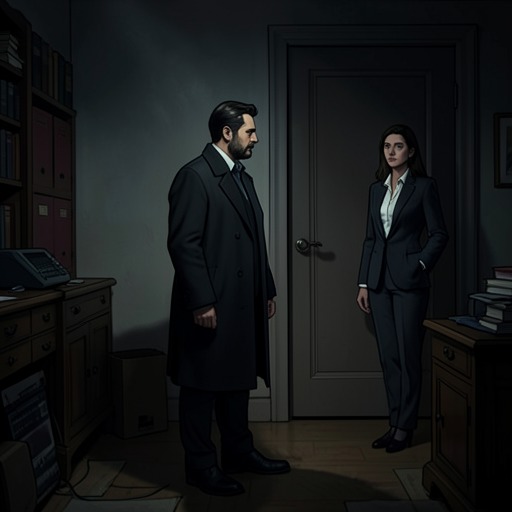
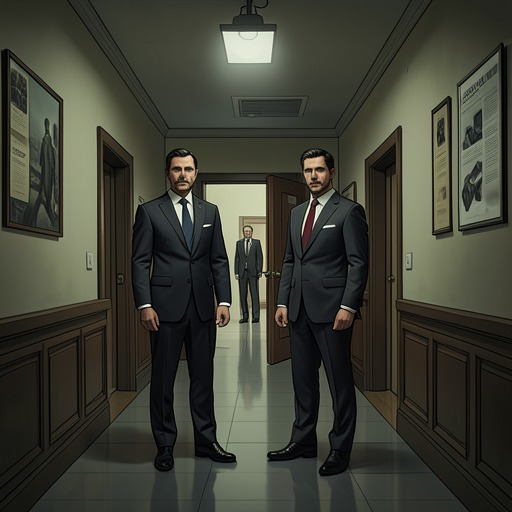
Pip and Arthur trapped in a room with no exit
The Portable DoorPip and Arthur’s imprisonment in a room with no exit begins with a magical doorway found in a strongroom and ends, for them, with nearly 130 years of confinement. Humphrey Wells deliberately seals them inside after they refuse to give him a talisman and learn too much about his business. Their predicament is revealed not as a recent mishap but as a long, unrecognized captivity, sustained by a vanished door, distorted time, and the difficult persistence of their friendship.
Discovery and confinement
Pip recounts that, after several quiet weeks, Casimir Suslowicz assigned the clerks to clear and organize the strongroom. On the final day, Humphrey Wells’s secretary brought down a box of miscellaneous objects. Inside was a cardboard tube containing an india-rubber mat shaped like a door. The clerks read its instructions, spread it against the strongroom wall, opened the doorway, and wedged it ajar with a heavy book. Cautiously, they directed it to take them only to their lodgings.
They emerged in their rooms, but the ordinary door connecting those rooms to the rest of the building was gone. Before they could do anything about this discovery, Humphrey appeared in the magical doorway. He told them that their refusal to hand over the talisman, together with their knowledge of his business, made it best to get them out of harm’s way for good. He slammed the doorway shut; it vanished without a trace, leaving Pip and Arthur inside a room with no door. The confinement is therefore not an accident of the doorway’s operation alone: Humphrey sees their refusal and knowledge as reasons to imprison them, then ensures that the route by which they arrived is no longer available.
Time without a measure
Pip tells Paul that he and Arthur have been there ever since. Paul reacts to the possibility that they have spent the best part of 130 years in the room, and Pip confirms the length of their confinement. Until Paul’s arrival made the passage of time legible, however, the clerks had no way to know how long it had been. They thought they might have been trapped for only a day or two, though the experience felt like a hundred years. Arthur likewise says that it felt like a hundred years, comparing that subjective duration to the seemingly endless experience of going to tea with his Aunt Elizabeth as a boy.
The discrepancy between elapsed time and perceived time makes the room more than a sealed location: it has also cut its occupants off from any reliable sense of history. Paul’s presence supplies an external measure, and the figure he raises forces the clerks to confront how much of the world may have changed. Arthur wonders whether they would feel at home in Paul’s time and points to women’s clothing as one visible difference. Their confinement has preserved their awareness of their immediate surroundings while withholding the ordinary signs by which they might have understood the decades passing outside.
A friendship under pressure
Pip and Arthur have endured the room together, but Pip describes the prolonged closeness as a serious strain on their friendship. He admits that he has sometimes felt he could strangle Arthur and has actually tried, several times. Stabbing, striking him over the head with a poker, and drowning him in a washbasin have likewise had no effect. The account gives no explanation for why these attacks fail; it establishes their ineffectiveness as part of the clerks’ grim routine rather than as a solution to their captivity.
Pip says he eventually gave up trying to harm Arthur. The two now mostly play chess, dominoes, or nomination whist, activities that relieve the tension without leaving the bad feeling their violence caused. The shift from repeated attacks to games does not erase the damage or make the confinement comfortable. Instead, it shows the pair improvising a way to live together after the room has deprived them of escape and ordinary measures of time. Their games offer a limited structure to an existence otherwise defined by repetition and enclosure.
The recognition that no one is leaving
When Sophie asks whether the clerks are coming back with the others, she makes explicit the consequence that their account has been approaching: the vanished doorway offers no route out. She says that none of them is going back, or going anywhere or anywhen; they are stuck because there is no door. Her blunt interruption turns the clerks’ long-standing imprisonment into an immediate crisis for the newly arrived group as well. The two men had endured their situation without knowing its duration; Paul and Sophie now understand the room as a trap with no evident exit.
The scene’s revelation depends on that contrast. Pip and Arthur’s account first describes an apparent escape to their lodgings, then the sudden loss of the real door, and finally a captivity whose duration they could not measure. Paul’s astonishment and Sophie’s certainty expose different dimensions of the same confinement: the nearly 130 years already endured, and the absence of any demonstrated way forward. The narrative establishes their imprisonment and the others’ recognition of its danger, but this passage does not show a successful escape.